The Magic of Story
|
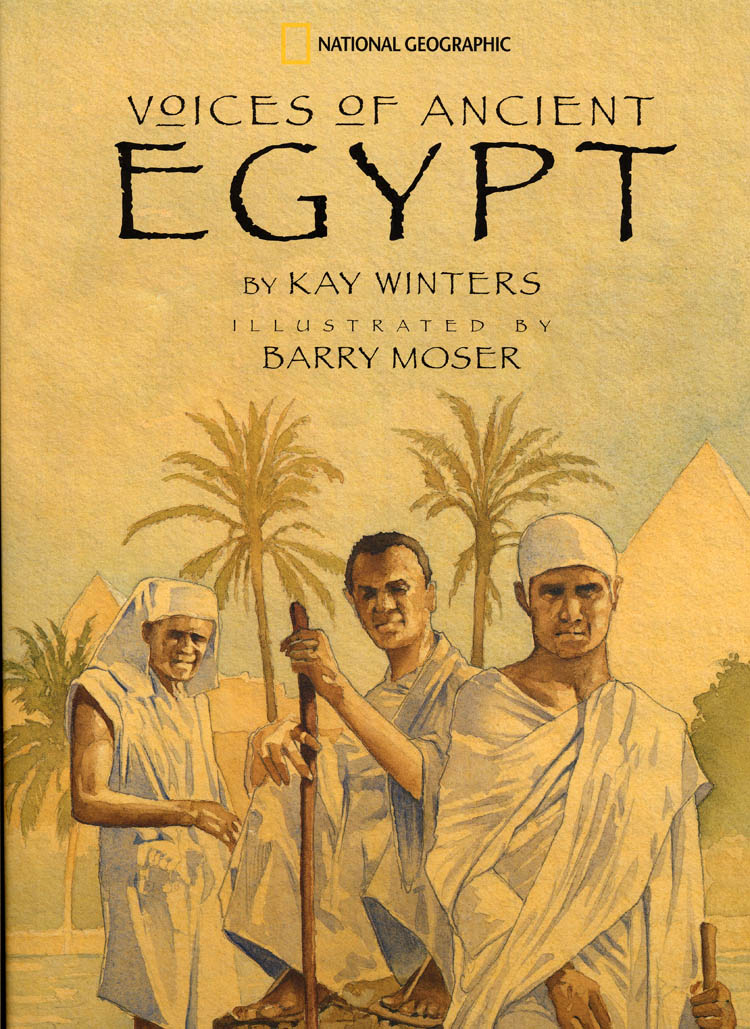
Home About Kay Books Author Visits Appearances For Writers Resources/Links What's New Voices of Ancient Egypt Illustrated by Barry Moser National Geographic, 2003 Cover Copyright © by Barry Moser, 2003 |
|
|
Voices of Ancient Egypt. A collection of poems and portraits of the workers during the Old Kingdom period. Hear the voices of the scribe, the dancer, the pyramid builder, the mummy maker, the marsh man, the washer of clothes, and others come alive. Ages 8 and up. |
| Author's Comments:
I
visited Egypt twice as a reading and language arts consultant in the
American International Schools of Cairo and Alexandria. I was fascinated by
this complex culture and wondered about the people who lived, loved and
worked in their villages along the Nile, thousands of years ago. Even
during the Old Kingdom which ended approximately 2000 BC, literacy was
valued. Parents hoped their sons and occasionally a daughter would become a
scribe, and bring the voices of the village alive. Much has been written about the Pharaohs who ruled the country for so many years, but little about the ordinary people. Come, walk in their sandals. Meet the dancer who performed at weddings and funerals, the birdnetter who wondered how it would feel to fly, the sailor who hoisted the sails like white wings of cranes, the marsh man who gathered the papyrus reeds that became paper. I played ancient music while I did my research. I went to museums, poured over tomb paintings and artifacts, watched videos, read letters, poems and documents from that early civilization. A magnificent era! |
| What Reviewers Said: In a starred review, Booklist reported, “Evocative words and an arresting design bring a long-gone civilization to life... A fine choice for social studies classes, where the book can be used for reader’s theater. School Library Journal: This book presents the voices of 13 individuals in various Old Kingdom occupations, ranging from scribe to herdsman. Winters uses first-person, free verse poems to describe the workers’ duties and places in society. Her verse is rich with informative detail. Moser provides visual context for the selections with delicately textured watercolors. Chicago Tribune: The 13 people whose voices Kay Winters projects includes no one royal or famous, and that was precisely Winters’ point… Each person is represented by a title in English and in ancient Egyptian hieroglyphics, a brief monologue and quite importantly a watercolor image by Barry Moser. Children’s Literature: … The award winning illustrator has provided a visual feel for the voices in this book in such a way that combined with the printed words, the reader truly obtains a sense of the peoples’ identity. A two page “ Historical Note” elaborating upon each of the profession has such historical clarity it should be read at the outset, not at the finish. PittsburghLive.com: Tribune Review Online: This
impeccably researched and fully referenced book - supported by a suite of
delicate watercolors by the noted Massachusetts artist Barry Moser -
transports young readers back into the daily rhythms of this long-ago
civilization, offering incisive portraits of such workers as scribe, farmer,
herdsman, goldsmith, embalmer, dancer, carpenter, sailor, pyramid builder,
weaver and bird-netter, all presented in first-person accounts of how they
went about performing their daily tasks. |
|
Awards / Book Club Selections:
Translated into Arabic Booklist Editors' Choice '03. Books for Youth editorial staff named it as one of their best-of-the-year selections. Hardcover copies included in Scholastic Book Fairs. Named by the Chicago Public Library to their Best of the Best list of recommended books for children and young adults published in 2003. Named a Notable Social Studies Book by the American Library Association and the Children's Book Council. Nominated for the Prairie Pasque Award from the South Dakota Library Association. |
Did You Hear
What I Heard?
Voices from the Underground Railroad
Pete & Gabby: The Bears Go to Town
The Bears Go to School (A Pete
and Gabby Book)
Voices from the Oregon Trail
This School Year Will Be THE BEST!
Colonial Voices - Hear Them Speak
My Teacher for President
Voices of Ancient Egypt
Abe Lincoln, The Boy Who Loved Books
Whooo's That?
The Teeny Tiny Ghost
Whooo's Haunting the Teeny Tiny Ghost
The Teeny Tiny Ghost and the Monster
Did You See What I Saw?
How Will the Easter Bunny Know?
But Mom, Everybody Else Does!
Tiger Trail
Wolf Watch
Who's Coming for Christmas?
Home | About Kay | Books | Author Visits | Appearances | For Writers | Resources/Links | What's New